Picaresque tradition
Lazarillo de TormesThe Picaresque tradition makes a life lived at society’s margins the thread through which a wider social world becomes visible. In Lazarillo, Lázaro’s account binds together episodic encounters with figures who otherwise remain confined to separate chapters; his hunger and survival give the narrative its continuity, while his perspective exposes the gap between imperial Spain’s public ideals and the lives of its poor.
Episodic Structure and Unity
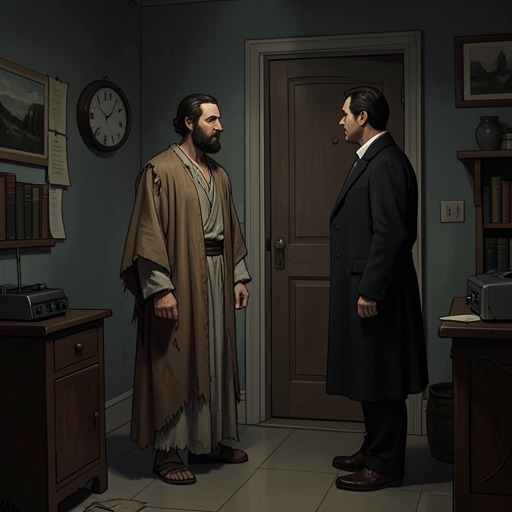
The book’s episodes are held together less by continuing interaction among its secondary characters than by their relation to Lázaro. The blind man appears only in the first chapter and disappears from the narrative when that chapter ends; the other figures likewise do not cross the boundaries of their assigned chapters. Their separateness gives the work an episodic, almost skewer-like construction, but Lázaro’s continuing life and narration keep the fragments coherent. The episodes can present distinct social conditions without requiring their characters to form a single interconnected cast.
This structure also shapes characterization. The blind man, priest, and squire are identified by their roles rather than personal names, so that each can stand for a category or condition. Lázaro is the exception: he alone, together with most of his named family, possesses a name and a continuing personal history. The formal contrast makes him the work’s point of connection and gives the reader a persistent perspective through which otherwise detached encounters acquire cumulative meaning.
The Marginal Protagonist and Social Vision
Lázaro’s repeated evocation of unappeased hunger makes survival the practical force behind his conduct. In the closing situation, he accepts a compromised domestic happiness rather than surrender the security he has attained: although rumours about his wife continue to circulate through the city and may even reach his superior, nobody now says anything directly to him. He insists that no woman in the city is better than his wife and declares himself ready to swear to it on the consecrated host or fight anyone who says otherwise. The comic bravado does not dispel the rumours; it shows how thoroughly the need to preserve his precarious good fortune has become more important than openly confronting them.
The account dates Lázaro’s prosperity and fortune by the visit of Charles V to Toledo for the Cortes. That imperial marker sets private survival against national grandeur. The book’s poor, petty thieves, and beggars belong to a Spain largely hidden behind the political and military spectacle of the empire, a society that receives none of the American gold and silver celebrated as its wealth. By giving this unofficial Spain a place at the centre of narrative, the work turns the socially marginal into witnesses to the conditions concealed by public magnificence.
Autobiography, Irony, and Legacy
The work recasts autobiography, a form traditionally associated with distinguished lives, exemplary cases, self-defence, or illustrious deeds. Instead, a low-born survivor narrates his life and explains the reasons for endurance to readers born to greater fortune. The first-person voice is present from the opening of the prologue to the final lines, making Lázaro not merely the protagonist of the episodes but the consciousness that interprets them. His account’s apparent self-justification carries a sharp irony: it makes survival legible while contradicting the official codes of honra and respectability by which society claims to judge it.
That combination of episodic realism, marginal viewpoint, and social satire helped establish the work as an early modern novel and a progenitor of the Picaresque tradition. Its influence extended beyond later Spanish writing to the eighteenth-century English novel. The form’s lasting force lies in the way it makes the poor person’s particular account—the life usually excluded from prestigious autobiography—capable of revealing an entire social order.